
Driving Hand Signals: Left, Right and Stop
There are three driving hand signals. Left turn: left arm straight out of the window. Right turn: left arm out and bent up at the elbow, palm forward. Slowing or stopping: left arm out and bent down at the elbow, palm back. All three are made with the left arm, because that is the arm a driver behind you can actually see.
They look like a relic, and most drivers go years without using one. Then a bulb goes, or a trailer hides the lights, and the signals are suddenly the only thing telling the car behind what you are about to do. Every state still recognizes them, and they turn up on the permit test in almost all of them.
Left turn
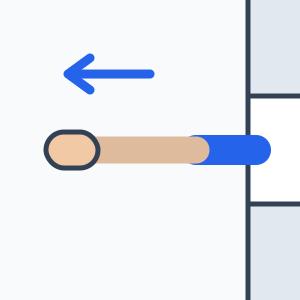
Put your left arm straight out of the window, level with the ground, hand open and fingers together. Hold it there until you start the turn.
The thing that makes it work is that it is the only signal with a straight arm. A driver behind you reads the silhouette long before they can make out your hand, so keep the elbow locked and the arm horizontal. A lazy, drooping arm looks like the slow-down signal, and that is a genuinely dangerous confusion.
Right turn
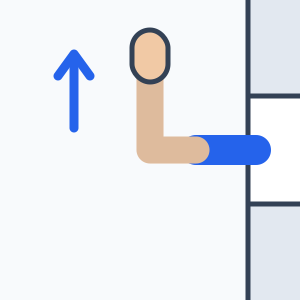
Left arm out of the window, then bent up at the elbow so the forearm points at the sky, palm facing forward. Upper arm horizontal, forearm vertical, a clean right angle.
Yes, you signal a right turn with your left arm. It reads backwards the first time, and that is exactly why it is on the test. The logic is simple: your right arm is invisible to everyone behind you, so every signal has to be made on the side people can see.
One exception worth knowing: many states also let a cyclist signal a right turn by pointing the right arm straight out, because a bike has no door in the way. Check your own handbook – the rule for cars is the bent left arm everywhere.
Slowing down or stopping
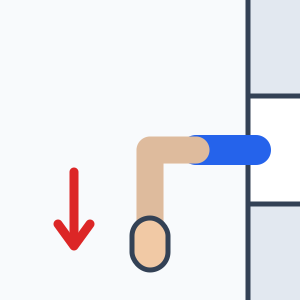
Left arm out, forearm bent down toward the road, palm facing back at the driver behind you. It is the mirror image of the right-turn signal, and the palm is doing real work here – an open palm facing someone is universally read as “hold up”.
This one has no equivalent on your car. Brake lights say you are already braking; this says you are about to. Used a beat early it buys the driver behind you a car length, which on a wet road is the whole margin.
The two people mix up
Up means right. Down means slow. That is the entire distinction, and it is the one that costs people a mark on the permit test.
If you want a hook that survives exam nerves: you point up toward the turn you are making, and down toward the brake pedal you are about to press. Nobody signals a left turn with a bend, so once you can separate up from down you have all three.
When the law actually requires them
Every state has a statute requiring you to signal a turn or a stop, and every one of them accepts either the lights or the hand. That means the signals are not a quaint alternative – they are the legal fallback, and when the lights cannot do the job the hand has to.
In practice you need them when:
- A bulb has failed. Not a hypothetical – you rarely notice a dead rear indicator until someone tells you.
- A load or a trailer covers the lights. Lumber over the tailgate, bikes on a rack, a hired trailer with no wiring.
- The sun is directly behind you. Low winter sun washes out an indicator completely; an arm still casts a shape.
- You are on a bicycle. Most bikes have no lights at all, and cyclists are held to the same signaling law.
- You are riding a motorcycle in a group. Riders use hand signals for far more than turns, and the three basics are the foundation.
Most states also set a distance: signal roughly 100 feet before the turn in town, and further at highway speed. Signaling as you begin the turn is legally late, whether you use a lever or an arm.
How to actually use them
Four things separate a signal that works from one that is technically present.
- Get the arm clear of the door. A hand held just outside the window sits below the eyeline of anyone in an SUV behind you.
- Signal early and hold it. A flick that lasts half a second is a movement, not a message.
- Return both hands to the wheel before you turn. The signal is finished once the turn starts, and one-handed steering through a junction is what an examiner will mark you down for.
- Use them with the lights, not instead. If a bulb is out on one side, the working side plus the arm is far clearer than either alone.
Check yourself
Hand signals show up as a picture question in most state exams. See how you handle them under exam conditions:
1. A driver ahead of you extends their left arm out of the window, bent upward at the elbow. What are they about to do?
Answer: Arm out and bent up means a right turn. It is made with the left arm because the right arm cannot be seen by traffic behind.
2. Which hand signal means the driver is slowing down or stopping?
Answer: Forearm down with the palm facing back is the slow-or-stop signal. Bent up is a right turn; straight out is a left turn.
3. Your right rear turn signal bulb has failed and you need to turn right. What should you do?
Answer: The hand signal is the legal fallback when a light cannot do the job. Hazards tell nobody which way you are going, and a false left signal is worse than none.
Driving Hand Signals: frequently asked questions
Are hand signals still legal?
Yes, in every state. Turn-signal statutes are written to accept a signal given either by an approved lighting device or by hand and arm, so the hand signals remain a valid way to comply – and the required one when your lights cannot do it.
Why do you signal a right turn with your left arm?
Because the right arm is hidden from everyone behind you by the body of the car. Every signal is made on the driver's side so traffic behind can see it, which is why the right-turn signal is a bent left arm rather than a pointed right one.
How far ahead do I need to signal?
Most states require about 100 feet before the turn in town, and more at highway speeds. The rule is the same whether you use the indicator stalk or your arm – signaling as the turn begins is already late.
Do cyclists use the same hand signals?
The same three, and cyclists are held to the same signaling laws. Many states additionally allow a cyclist to signal a right turn by extending the right arm straight out, since there is no door blocking the view – check your state handbook for that variant.
Are hand signals on the permit test?
In most states, yes. They appear in the driver handbook and the question almost always asks you to identify one of the three from a description or a picture – usually the right turn or the stop, because those are the two people confuse.
- Uniform Vehicle Code – turning and stopping signals
- Your state driver handbook – the signaling chapter
Put it on the exam clock
Free practice tests built from your own state's exam material, with an explanation after every answer.
Start a free practice test →- Uniform Vehicle Code - turning and stopping signals
- Your state driver handbook - the signaling chapter